"It is an odd thing, I believe, to be constantly looking down at the ground, always searching for broken and discarded things. After a while, it must surely affect the brain. For nothing is really itself anymore. There are pieces of this and pieces of that, but none of it fits together. And yet, very strangely, at the limit of all this chaos, everything begins to fuse again...As an object hunter you must rescue things before they reach a state of absolute decay. You can never expect to find something whole-for that is an accident, a mistake on the part of the person that lost it-but neither can you spend your time looking for what is totally used up. You hover somewhere in between, on the lookout for things that still retain a semblance of their original shape-even if their usefulness is gone."
Paul Auster 'In the Country of Last Things' Faber and Faber, London 1989, p.35-36
'He who makes a garden, his own unmaking makes.'
"One might harvest the garden, but to do so or not to do so will not determine the status of the space as a garden. In making a garden one composes with living things, intervening in and contextualizing, and thus changing, their form without determining all aspects of their development or end."
Susan Stewart 'The Open Studio' The University of Chicago Press, London 2005, p.111
Day of the Triffids
Cover Design: Harry Willock
'The Man Who Mistook His Wife for a Hat'
"The presence of others, other people, excite and rattle him, force him into an endless, frenzied, social chatter, a veritable delirium of identity making and seeking; the presence of plants, a quiet garden, the non-human order, making no social or human demands on upon him, allow this identity-delirium to relax, to subside; and by their quiet, non-human self sufficiency and completeness allow him a rare quietness and self-sufficiency of his own, by offering (beneath, or beyond, all merely human identities and relations) a deep wordless communication with Nature itelf, and with this the restored sense of being in the world, being real."
Oliver Sacks 'The Man Who Mistook his wife for a Hat' Pan Books, London 1986, p.110
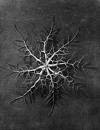
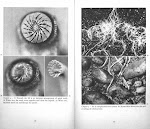
Karl Blossfeldt
'Objects and Apparitions'
(For Joseph Cornell)
'Minimal, incoherent fragments: The opposite of History, creator of ruins Out of your ruins you have made creations.'
"This must be the wood," she said thoughtfully to herself, "where things have no names. I wonder what will become of my name when I go in? I shouldn't like to lose it at all - because they'd have to give me another, and it would almost certainly be an ugly one. But then the fun would be, trying to find the creature that had got my old name!"
Lewis Carroll 'Through the Looking-Glass' Penguin Books, London 1998, p.152
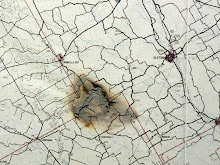
Cornelia Parker
Meteorite Misses Waco Texas (2001)
Tony Cragg
"But the studio can also become very provincial, it can become a province of its own"
Tony Cragg Interviewed by Robert Hooper, Tuesday 5th November 1996, 'Tony Cragg' The Art Gallery of NSW, Sydney 1996
The Museum of Unnatural History
Terence Bumbly
'Gems and Jewelry'
Joel Arem (Peridot)
'How I classify'
"The sheer number of the things needing to be arranged and the near-impossibility of distributing them according to any truly satisfactory criteria mean that I never finally manage it, that the arrangements I end up with are temporary and vague, and hardly any more effective than the original anarchy. The outcome of all this leads to truly strange categories. A folder of miscellaneous papers, for example, on which is written 'To be Classified'..."Georges Perec 'Species of Spaces and Other Pieces' Penguin Books, London 1999, p. 196
'Futile Gestures: Photo Albums and the Ecology of Memory' Faith Moonsang
"As Stephanie Snyder notes in Snapshot Chronicles: Inventing the American Photo Album, it is precisely because these albums flourished in the domestic sphere, removed as they are from the institutional protection of a museum or gallery, that they are vulnerable to neglect and disappearance. To attempt to forestall the process of neglect and disappearance is the futile gesture, the essential gesture, of the collector."
"The utterly self-sufficient, unchanging reality of the things surrounding her began to depress Agnes...She felt choked, smothered by these objects whose bulky pragmatic existence somehow threatened the deepest, most secret roots of her own ephemeral being."
Sylvia Plath 'Johnny Panic and the Bible of Dreams' The Wishing Box Faber and Faber, London 1979, p.53
Ilya Kabakov
The Flying Komarov (1981) no. 13
'Street Haunting: A London Adventure' Virginia Woolf
"Second-hand books are wild books, homeless books; they have come together in vast flocks of variegated feather, and have a charm which the domesticated volumes of the library lack."
"The flowers grew to a height of about six feet, their slender stems, like rods of glass, bearing a dozen leaves, the once transparent fronds frosted by the fossilized veins. At the peak of each stem was the time flower, the size of a goblet, the opaque outer petals enclosing the crystal heart. Their diamond brilliance contained a thousand faces, the crystal seeming to drain the air of its light and motion."
J. G. Ballard 'The Complete Short Stories: Volume 1' The Garden of Time Harper Collins, London 2006, p. 406
Simryn Gill
Untitled (2006)
'The Service of Clouds'
"Down by the river, time squatted on its haunches. Long strips of bark hung from the gums, flayed by their own expansion. A large geebung tree had toppled sideways from the cliff; caught by the scrub, it was held in the act of falling, inches from the ground. Green creepers spread across it...'It is a slow catastrophe' I said."
Delia Falconer 'The Service of Clouds' Picador, Sydney 1998, p.198
See How they Grow
A Pelican Book: M. Field, J. Valentine, F. P. Smith
Found
Charity Shop Doilie
'Window'
"Window." There is a poetic image to be found in the origin of the word "window". It derives from two Scandinavian terms, vindrand auga, meaning "winds eye". Early Norse carpenters built houses as simply as possible. Since doors had to be closed throughout the long winters, ventilation for smoke and stale air was provided by a hole, or "eye", in the roof. Because the wind frequently whistled through it, the air hole was called the "wind's eye". British builders borrowed the Norse term and modified it to "window". And in time, the aperture that was designed to let in air was glassed up to keep it out."
Charles Panati 'Extraordinary Origins of Everyday Things' Harper & Row, New York 1987, p.158
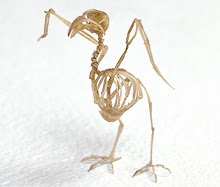
Tim Hawkinson
Bird (1997)
'The Shadow'
"Imagine!...Oh how fragile a shadow's brain must be!...Imagine, my shadow has gone mad. He believes he is a man. And that I am his shadow!"
Hans Christian Andersen 'A Treasury of Hans Christian Andersen' The Shadow Nelson Doubleday, New York 1974, p.261
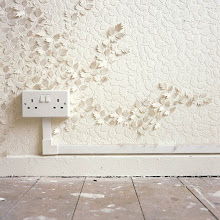
Catherine Bertola
If walls could talk (2002)
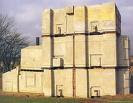
Rachel Whiteread
House (1993)
'Parable of the Palace'
"What we do know - however incredible it may be - is that within the poem lay the entire enormous palace, whole and to the least detail, with every venerable porcelain it contained and every scene on every porcelain, all the lights and shadows of its twilights, and every forlorn or happy moment of the glorious dynasties of mortals, gods, and dragons that had lived within it through all its endless past. Everyone fell silent; then the emperor spoke. "You have stolen my palace!" he cried, and the executioner's iron scythe mowed down the poet's life.
Others tell the story differently. The world cannot contain two things that are identical; no sooner had the poet uttered his poem than the palace disappeared, as though in a puff of smoke, wiped from the face of the earth by a final syllable."
Jorge Luis Borges 'Collected Fictions' Parable of the Palace Penguin Books, London 1998, p. 318
Born in Sydney, grew up in the Blue Mountains.
Currently a Post-Graduate Student at Sydney College of the Arts.
Completed BVA (Hons) SCA in 2006.
This Blog haphazardly records the objects, arrangements and processes of my studio space.